
If Figma Falls, What Replaces it? AI still hasn't built.
The real bottleneck in enterprise websites isn’t building. It’s alignment.
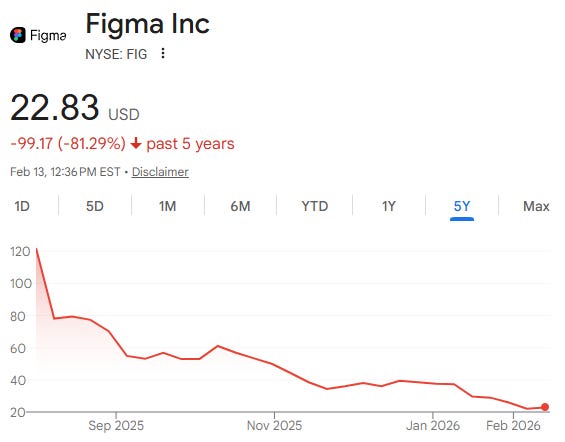
That is a steep decline. There’s noise about Figma slowing down, competition rising, AI tools generating layouts in seconds.
Fine.
But after years of building enterprise websites, some of them running 10–15 years, across small sites and massive platforms with thousands of pages, I can say this confidently:
Figma is not just a design tool.
It is an alignment engine.
And alignment is the hardest part of enterprise digital work. Actually building the website is the easy part.
The process before code touches production is where the real complexity lives.
Business sends plans to marketing.
Marketing shapes positioning and sends direction to design.
Design iterates.
Marketing pushes back.
Accessibility reviews.
Legal comments.
Engineering evaluates feasibility.
Back and forth. Sometimes for weeks.
In large enterprises, I’ve even seen multiple design agencies hired for the same concept. Parallel explorations. Competing directions. The organization chooses the one that best aligns with long-term strategy.
That entire negotiation happens before development begins.
Figma became the shared visual brain for that process. Everyone sees the same thing. Everyone comments in one place. Version history is visible. Decisions are anchored to a visual artifact.
If Figma declines, the replacement cannot simply be:
“AI that generates a homepage.”
That solves the wrong problem.
AI today is excellent at creation. Prompt in, artifact out. It accelerates drafts. It reduces blank-canvas friction. But enterprises are not bottlenecked by blank canvases.
They are bottlenecked by consensus. What replaces Figma must do more than generate.
It must:
Host structured review cycles.
Support traceable approvals.
Bridge business, marketing, design, and engineering.
Understand design systems at scale.
Manage change across hundreds or thousands of pages.
We do not yet have an AI-native design collaboration layer that fully does this.
There is no intelligent consensus system that understands enterprise governance while being collaborative and visible. If Figma weakens, the winner won’t be a generative UI tool. It will be the platform that becomes the next shared system of truth for digital experience.
AI will be part of it. It has to be.
But generation is not enough.
The next layer needs to help organizations move from
idea → debate → alignment → approval → implementation with clarity.
Until something does that better than Figma, Figma’s role remains structurally important.
The real disruption won’t be AI replacing designers.
It will be whoever replaces the enterprise design brain.
- Suren