
From Search to Ads to Commerce: The Systems Shift From Google
What Vidhya Srinivasan's third annual letter signals for the future of AI-powered advertising
Vidhya Srinivasan’s 2026 third letter reads like an ads update.
It’s not.
It’s an architectural forecast.
If you zoom out, what she’s describing is commerce evolving from page-based interaction to AI-orchestrated systems. Search becomes conversational. Checkout becomes agent-driven. Creative becomes generative. Measurement becomes unified intelligence.
That’s not marketing innovation.
That’s software engineering territory.
Search Is No Longer a List. It’s a Runtime.
AI Mode reframes Search as a live reasoning environment. Users brainstorm, compare, refine, and decide within a flowing context. Ads do not interrupt the experience. They participate in it.
From an engineering perspective, that means:
The system must track conversational state.
Intent must be dynamically re-evaluated.
Sponsored results must pass semantic relevance and policy checks in real time.
We are moving from index-based ranking to orchestration engines.
That is a fundamentally different design problem.
Influence Becomes Programmable
YouTube being positioned as a commerce bridge is really a graph intelligence story. Creator content, audience embeddings, and brand intent all converge in large-scale similarity systems.
But the interesting shift is this: influence is becoming machine-readable.
When AI can understand community affinity at scale, matching brands to creators stops being manual partnership management. It becomes infrastructure.
Commerce pipelines become composable. Influence becomes queryable.
That is a big leap.
Agentic Commerce Is About Protocols, Not Pages
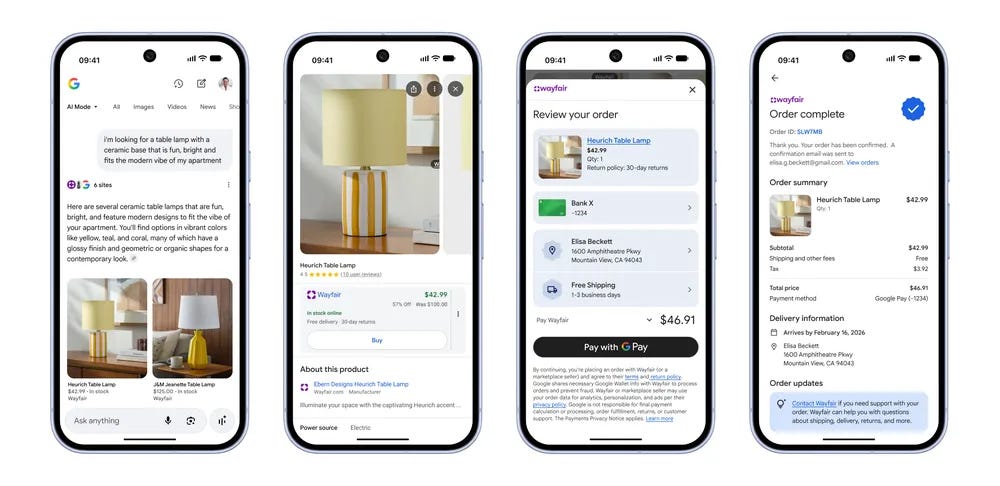
The Universal Commerce Protocol layered on top of Agent Payments Protocol is the most strategic signal in the letter.
Google is building a shared language for AI agents and merchants to transact securely.
That is not checkout optimization.
That is protocol design.
When an AI agent can represent a user, authenticate identity, negotiate offers, and complete payment across retailers without redirect loops, we are looking at a new commerce layer entirely.
Retailers stop being destinations. They become service endpoints.
This introduces real engineering challenges:
Delegated authority
Secure identity verification
Consent validation
Distributed observability
Agentic commerce is distributed systems engineering wrapped in a shopping experience.
Where Enterprises Come In
This is where it becomes especially relevant for large organizations.
Most enterprises today operate on digital marketing platforms such as:
Adobe
Salesforce
OpenText
These platforms power content management, customer data platforms, campaign orchestration, personalization engines, and commerce stacks.
Until now, the integration pattern has largely been:
Experience platform → Campaign execution → Ad network → Reporting loop.
AI-native search and agentic commerce disrupt that flow.
Now enterprises can:
Expose product catalogs and offers as structured, agent-readable endpoints.
Integrate identity systems with commerce protocols.
Feed first-party data into conversational discovery surfaces.
Re-architect measurement stacks to align with AI-driven attribution.
Instead of pushing traffic into a site, they can participate directly in AI-mediated journeys.
That creates entirely new integration surfaces between enterprise platforms and ecosystems like AI Mode.
For software engineers inside large organizations, this means building APIs and data pipelines that are agent-compatible, not just browser-compatible.
It means thinking about product information as structured intelligence, not page content.
It means preparing CDPs and commerce engines to operate in a protocol-first world.
Gemini 3 and the Abstraction Discipline
Gemini 3 improving underlying ad systems without customers needing to change anything is a quiet architectural flex.
It signals strong abstraction layers between model evolution and application interfaces.
Enterprises need to adopt the same discipline.
Models will change. Latency will improve. Capabilities will expand.
If your workflows break every time a model version updates, you are coupling too tightly.
AI-native systems require clean contracts and strong evaluation layers.
The Bigger Shift
What we are witnessing is a reframing of digital commerce as a network of intelligent systems.
Search becomes a reasoning layer.
Creators become structured influence nodes.
Checkout becomes protocol exchange.
Measurement becomes unified intelligence fabric.
Enterprise platforms become integration hubs for AI agents.
This is not just about ads performing better.
It is about enterprises rethinking how their architecture participates in AI-driven ecosystems.
The expansionary moment she described will reward organizations that redesign their systems for interoperability, trust, and semantic intelligence.
The question is no longer whether AI will reshape digital commerce.
The question is whether our software architecture is ready for it.